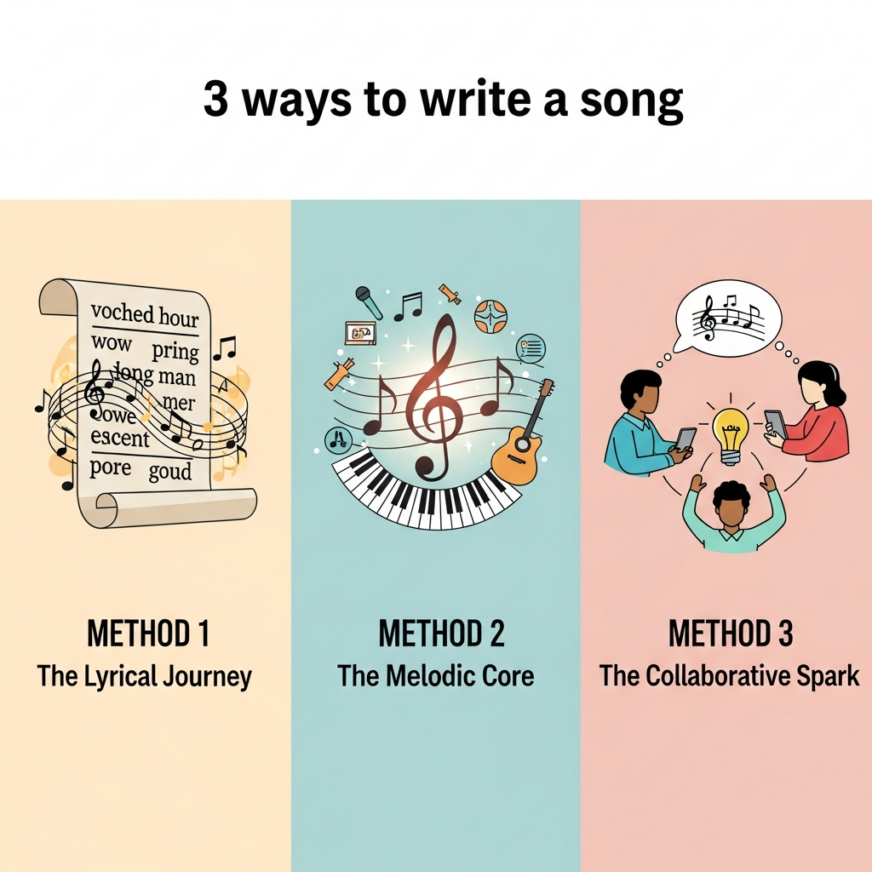
Write music to prepared song lyrics.
What do you need to do to write music to lyrics?
What’s most important here: rhythm, tempo, and melody.
You have lyrics and you’re deciding where to start. Since you can start with any component, I think you’ll be interested to know exactly what to do:
RHYTHM
— Read the lyrics several times.
— Mark the places you think contain a rhythmic beat.
— Don’t forget about pauses; use your imagination and place them in the lyrics, as if you were reading actors’ lines in a theater.
— Duplicate words if necessary.
Of course, when you’re finishing the melody, you’ll return to the rhythm to correct any areas that don’t sound quite right.
TEMPOSURE
— Decide whether the tempo will be constant throughout the piece or will it change, and explain why.
— If you speed it up, where? If you slow it down, where? Again, why?
Here, too, you’ll have to return after the melody and rhythm and repeat the cycle again until it becomes more or less acceptable (for you).
MELODY
Some books advise that, as a composer, you should come up with a sound for each syllable, word, and sentence in advance, but I don’t recommend this approach, as creativity will turn into programming.
You look and see the word “rain.” So, in our notebook, “rain” should sound like a B-flat. Well, that’s nonsense. So what, every time the vocalist sings the word “rain,” they have to repeat the same note?! Well, guys, that’s not creativity anymore.
Writing music to a ready-made text is only more difficult for those who think in images. In fact, we already have a template (rhythm and tempo); all we need to do is extract complete sentences from the text and create melodies (from 1 to 3-4 notes). We repeat the melodies we like, but always create variations. This forms the foundation.
I’d like to draw your attention to the structure of the text (if the author uses stanzas, you should ask what they are and why; if you wrote them yourself, decide whether there will be a chorus, pre-chorus, etc.).
The melody structure will be repeated in the chorus and in the verse, but can also vary.
The melody is there, and that’s enough. Now we need to return to the rhythm and tempo and refine it to the desired result.
Of course, many people can simply pick up a guitar or sit down at the piano keys and absentmindedly hum something (lyrics), choosing a melody and intuitively placing chords. That’s also a good method. Everyone has their own.
I’d like to say a little about dynamics.
It’s best to keep the volume consistent throughout the song. Later, when you’re playing the parts and adding vocals, that’s when you can adjust the dynamics. As for the vocals, for some people “loud” will be very loud, and “soft” will be louder than you’ve written in the parts or agreed upon with the sound engineer. And with instruments, things can get really confusing. Keyboards can drown out the toms on the drums, and the guitar will drown out the vocals and cymbals. So, it’s best to set the volume consistently throughout from the very beginning. Then experiment as much as you like.
Write in the comments how you compose music!
If you want to know more, leave your contact information and I will help you!
