
How do you find a solution when you don’t know what to do?! Where do you start?! How do you start making money from your creativity? How do you learn to play a musical instrument or sing? How do you learn to make something with your own hands?
There’s a simple method for all these questions. Learn it and apply it to your situation.
This method will be useful not only for musicians but also for a general readership. Its essence is as follows.
We always have several ways to solve a problem. And according to psychologists, there are at least five. These paths are indicated by red vectors in the figure. For simplicity, I have depicted the model as a diagram.
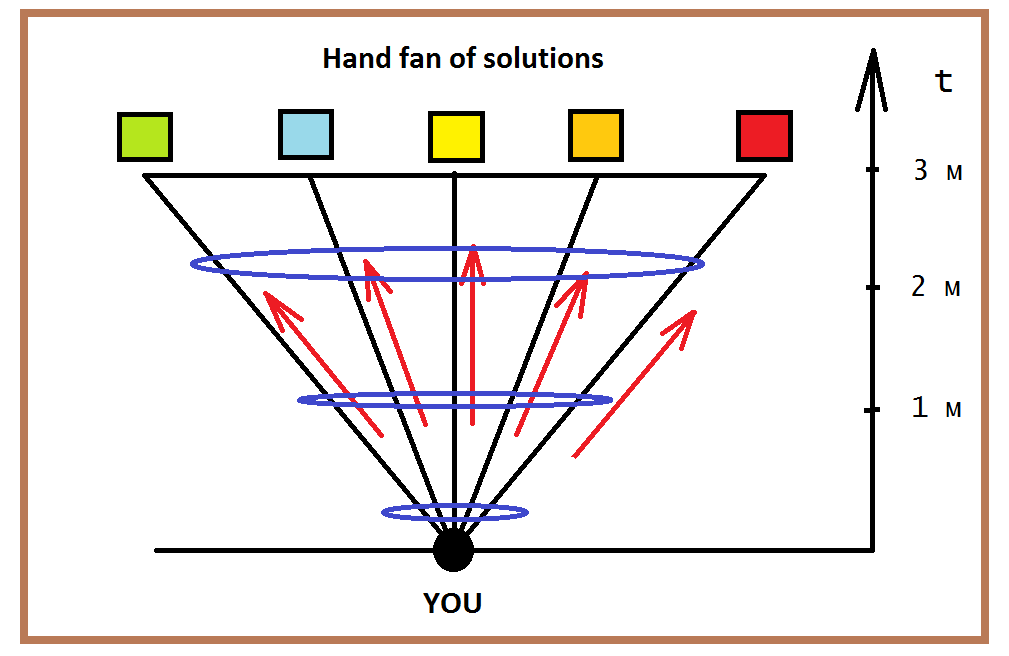
The decision we make determines the final result (squares) we achieve after 90 days (the vertical scale is marked with dashes for 1 month, 2 month, and 3 month).
Red means we did nothing and things got worse over time.
(For example: a tutor with a higher music education, say, a conservatory graduate, decides that everything will settle down, that she will be accepted into any institution, and does nothing, or simply has a “status” that is too much.)
Orange means we are doing the same thing, but the result remains poor.
(For example: a tutor with a degree in music, let’s say a conservatory graduate, decides, okay, it’s a change, I’ll just tutor at home, let them come—but no one will.)
Yellow means we’re doing too much, even unnecessary things, but we’re doing it, and the result is pretty good, but still not what it should be.
(For example: a tutor with a degree in music, let’s say a conservatory graduate, decides to put their “status” to shame and take a job as a cleaner, a nanny in the evenings, and perhaps another part-time job. There are results, but they’re not satisfied; the person remains at the same level, but with more effort than before.)
Blue means we’ve found a solution. We understand that we don’t need to do everything indiscriminately, but rather, we need to selectively implement a well-established algorithm, and we’re getting good results.
(For example: let’s take our poor tutor with a higher musical education, say, a conservatory graduate, and she decides to switch to online teaching and use her experience and diploma to teach students. Her “status” has surfaced and she’s comfortable with the realities of life.)
Green means we know what we need, have found someone who’s already where we want them to be, and through training, we’re reaching a new level of quality.
(For example: a tutor with a higher musical education, say, a conservatory graduate, one day attends a webinar by a woman who outshines our tutor in terms of credentials, but has been teaching and learning online for a long time. Then her “status” sits quietly and doesn’t bother her, and our tutor goes to study with that woman and, as a result, earns a comfortable income, thereby increasing her potential for further growth.)
Everything seems clear, but there’s one complication.
The point is that if you choose the “orange” or “yellow” option, over time, if you suddenly feel like you’re “driving in the wrong direction,” it will be much more difficult to switch (blue ovals) to the “blue” or “green” option. As you can see in the figure, this will require significant changes (temporary and personal).
At the beginning of the journey, before making a choice, it’s easier to change your mind (blue oval narrower) than after three months.
Still, it’s up to you to decide!
