Before learning a piece of music, you need to consider how long it will take to learn, what technical skills are required to perform it, etc. After that, you need to figure out how you can learn and perform the song or piece in front of someone faster (I’m not talking about quality here).
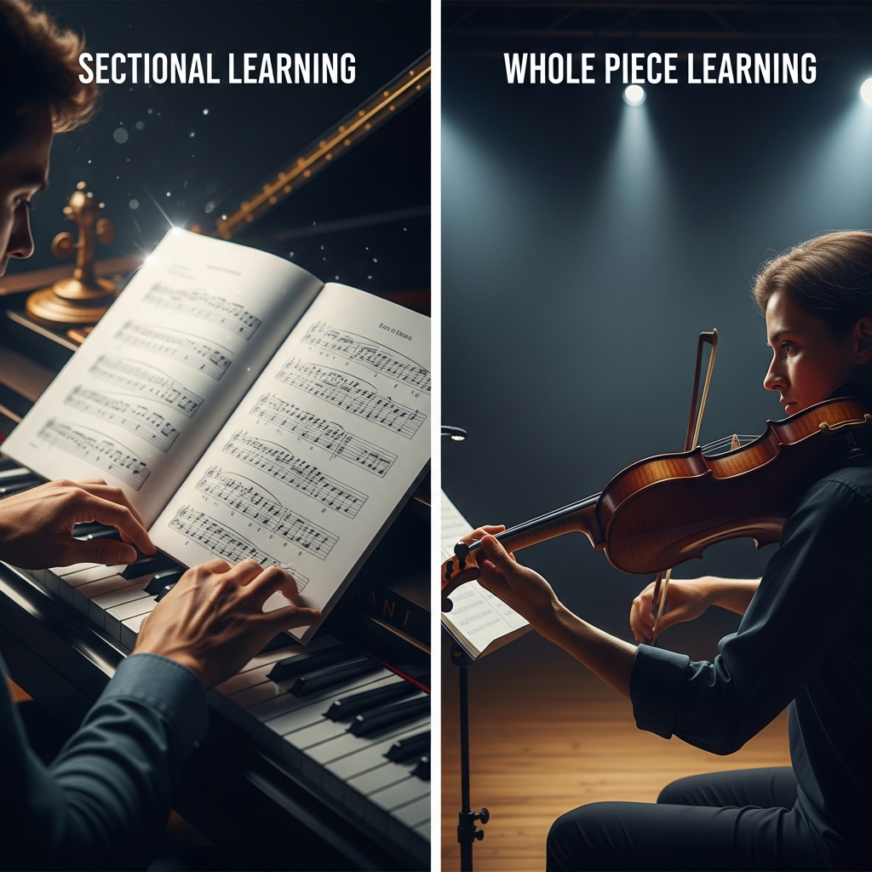
- If the piece is short (a song, etude, sonatin, piece, etc.) and requires minimal technique, then it’s better to simply play it from beginning to end exactly as you can, then go back to the beginning, play it again, and then play it again until you’ve mastered it more or less.
Example:
I taught a very determined person, already an adult. He had never held a guitar, but REALLY wanted to learn. Within a month!!!, he was playing and SINGING fluently!!!!! Moreover, the song had a challenging strumming and a rather complex melody. His secret is simple: he simply hammered out the same strumming every day, polishing it as much as he could and as much as his strength allowed (and it must be said, he had plenty of strength). Everyone was tired of him, but he still didn’t stop playing. I hope his determination helped him master different types of strumming. Such people always achieve what they want.
- If the piece is large (a sonata, a concerto, a sequence of songs, a long melodic part, etc.) and the technical skills in it are not comparable to yours, then it’s important to systematically, step by step, dividing the piece into small pieces, first studying the technical device that makes up/is present in the given section, and only then combining everything into a coherent piece.
Example:
I remember, at university, a guy, my peer and a fellow correspondence student, helped me with classical guitar. He played simply beautifully. Many of the earliest Baroque pieces he played were truly brilliant. But he didn’t just play gimmicks; he played entire pieces, which is what separates a professional from an amateur. I asked him, “Tell me, how do you learn and memorize so many pieces?” He reluctantly replied, “I sit and pore over every note, every interval, and every chord until I get them, at least well. I don’t move on until I’m completely satisfied with the sound of the strings.” And indeed, the last time he helped me master my program, I noticed that even familiar pieces he still analyzed with meticulous attention to every detail. And yes, thank you for his help.
So, musicians, there are always at least two paths…
