
Finger endurance is directly related to the tension in the hand and the fingers themselves. The more tension the hand has, the less time it can work without a break. The less tension the hand has, the more likely it is to perform effectively.
Initially, a person can’t hold a chord for even a minute – the hand weakens quickly, and so do the fingers. Over time, with a little practice, a beginner is quite capable of playing an entire song (usually open chords; few progress to barre chords). And that’s where many people stop practicing.
To reach the next level, some still play closed chords, pressing with all their might with all the fingers involved in the fingering. As a result, after playing one or two songs, the hand begins to ache, ache, or tighten.
Of course, some fingers are naturally resilient, but in most cases, endurance needs to be increased.
There are many techniques for increasing finger endurance. Each has its own unique character.
To play without pain or aching in your hands, you need to press the strings firmly, only the ones you’re playing. You just need to feel the others with your fingers and press them against the fretboard at the right moment.
For example (playing scales):
Play a section of an ascending scale.
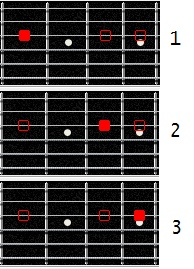
- The index finger presses the string firmly, without any creaking or popping. All tension is concentrated on it.
- Then, the tension moves from the index finger to the ring finger. The index finger is gently lifted above the fretboard, just feeling the string.
- Then, the tension smoothly flows to the pinky finger, while the other fingers rest.
Play a section of a descending scale.

- Initially, the tension is on the pinky finger, while the other fingers rest quietly on the string.
- Then, the tension moves from the pinky finger to the ring finger. The pinky finger is lifted and rests.
- Afterwards, the tension smoothly flows into the index finger, while the other fingers are raised and resting.
For example (barre playing):
Play an A minor chord. On the barre, 5th fret.
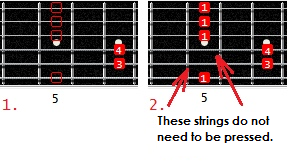
Beginners often make a mistake by placing the index finger first, followed by the rest. I recommend placing the fingers that are attached to the strings first.
That is, we first place the pinky and ring fingers on the 4th and 5th strings of the 7th fret, respectively, and then cover the fretboard with the index finger on the 5th fret.
So, the index finger presses the 1st, 2nd, 3rd, and 6th strings, while the ring and pinky fingers press the 4th and 5th strings. The middle finger is gently placed on the index finger.
Practice all possible barre chords this way. You’ll immediately feel stronger and able to play longer.
