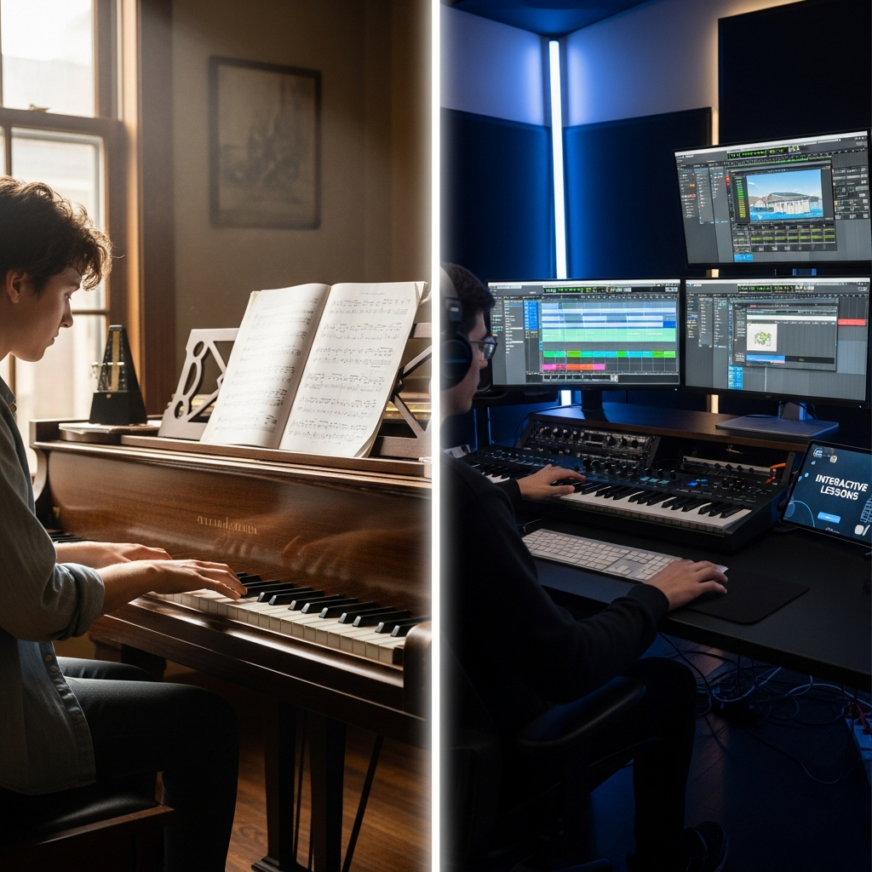
I’d like to immediately differentiate the two learning systems and explain them in simple terms.
An adapted system is one where there’s a model, and we learn from it.
Example: There are notes of a melody on a piece of paper. You study it and play it.
A unique system is one where there’s no model, and we learn through trial and error.
Example: You hear a melody, play it on an instrument, and write it down on a piece of paper.
In the first case, we learned something created by others, and to learn something different, we definitely need a template. In the second case, we learned something created by others, but by using our own experience, we can seamlessly repeat the same actions that led us to the result, without using templates.
We’ll consider each system from the perspective of the student (as if they were learning independently) and from the perspective of the teacher (as if someone were learning with a specialist).
Adapted Learning System.
From the student’s perspective:
With this system, the student first learns something that has already yielded results for others, sees their examples, and tries to ADAPT this system to their own needs. In most cases, the results will be worse than those of those from whom the system was copied, but the student will still achieve minimal results.
Here, we can observe external learning.
From the teacher’s perspective:
With this teaching system, the teacher will constantly demonstrate what THEY WANT to teach the student. The student, in turn, will REPEAT everything they see. The teacher doesn’t try to push the student to think; they demand that everything be done precisely as they were told. The student will consider such a mentor an expert, and whether they like it or not, they will have to comply with all requirements, otherwise, they will not achieve their goal.
Pros:
- there’s a ready-made model (just go and do it)
- works well for a specific goal
- quick to achieve (but not necessarily high-quality)
Cons:
- no strong connection with the brain (simple memorization, cramming)
- lack of flexibility and agility (the template is repetitive)
- develops an inferiority complex (lack of faith in achieving this through one’s own efforts)
A unique learning system.
From the student’s perspective.
The student gains knowledge, skills, and abilities through their own experience. As a result, everything the student has learned is permanently imprinted in their subconscious.
Internal learning occurs.
From the teacher’s perspective.
In this system, the teacher MONITORS the student’s learning. He does not correct the student’s mistakes, but NOTICES them. He tells you what to do and how to do it, but DOESN’T DEMONSTRATE how a specific action should be done and then WATCHES how the student performs it.
In this system, the mentor is much less present. All the attention is on the student.
That’s why I like this particular learning system. After this “school,” the student will be able to figure out when to apply each skill.
Pros:
- Flexible and multifaceted system (so many people, so many approaches)
- Works for learning the algorithm (so you don’t have to watch a song every time, but can just pick up and analyze any song yourself)
- Stays with you forever (all NATIVE movements and actions are processed through the brain)
Cons:
- No ready-made model (the model is formed during training)
- Difficult to work with templates
- Takes longer to integrate (but is high-quality)
In conclusion.
If you want to learn just one song or piece, it’s better to use the adaptation system.
But if you want to understand and develop the skill of analyzing and performing songs, I highly recommend using the uniqueness system.
Now you have standards for learning anything. Use them!
